At Core to Calm, we believe recovery is just as important as the workout itself. Whether you’re a yogi, a lifter, or someone who simply wants to soothe tight muscles, the right foam roller can transform your routine.
But with so many options on the market, how do you choose? Today, we’re breaking down three popular types of foam rollers from our collection:
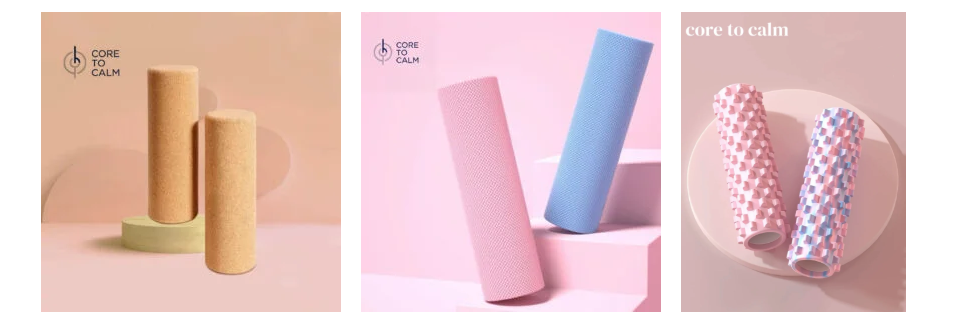
- Solid Cork Foam Roller
- Solid EVA Foam Roller
- EVA Foam Roller with PVC Core
Let’s dive into their differences, how they feel, how to use them, and which one fits your needs best.
1. Material & Construction – What’s Inside Matters
| Feature | Solid Cork | Solid EVA | EVA with PVC Core |
|---|---|---|---|
| Core | 100% natural cork (solid) | Dense EVA foam (solid) | Lightweight EVA foam around a rigid PVC tube |
| Density | High / firm | Medium to firm | Medium (soft feel, rigid support from core) |
| Eco‑friendliness | Biodegradable, sustainable | Synthetic, but often recyclable | Mixed (PVC not biodegradable) |
| Weight | Heavy | Moderate | Light |
Quick take:
- Solid Cork – For those who love natural materials and deep, firm pressure.
- Solid EVA – The all‑rounder: durable, affordable, and consistent.
- EVA + PVC Core – Lightweight and travel‑friendly, with a softer surface.
2. User Experience – How They Feel on Your Muscles
🟤 Solid Cork Foam Roller
Feel: Firm, almost like a wooden roller but with a bit of natural grip. Cork doesn’t compress much, so you get intense, deep‑tissue pressure. Best for: Advanced users, athletes with chronic tightness, and anyone who likes a “hurt so good” sensation. Noise: Silent – no squeaking. Grip: Excellent – cork’s texture prevents slipping, even when you sweat.
⚪ Solid EVA Foam Roller
Feel: Dense but with slight give. It’s firm enough to release knots but not punishing. Best for: Daily use, beginners to intermediate, and general muscle maintenance. Noise: Silent. Grip: Good, but smooth EVA can be slippery if wet – use a towel or mat.
🔘 EVA Foam Roller with PVC Core
Feel: Soft and cushioned on the outside, yet the PVC core prevents collapse under body weight. Low to medium pressure – great for sensitive areas. Best for: Beginners, post‑injury recovery, or upper body rolling (e.g., arms, calves). Noise: Silent. Grip: Similar to solid EVA – decent, but watch for sweat.
💡 Pro tip: If you’re unsure, start with solid EVA. It’s the most balanced option for most people.
3. Step‑by‑Step Tutorial – How to Use Each Roller
These techniques work for all three types – just adjust pressure according to how firm your roller is.
🦵 Calves (for tight lower legs)
- Sit on the floor, legs extended. Place the roller under your mid‑calf.
- Lift your hips, cross one ankle over the other for added pressure.
- Roll slowly from just above the Achilles to below the knee.
- Pause on tender spots for 20–30 seconds.
- Which roller shines? Solid cork for deep knots; EVA+PVC for gentle relief.
🍑 Glutes & Piriformis (sciatica relief)
- Sit on the roller, hands behind you for support.
- Cross one ankle over the opposite knee (figure‑4 position).
- Lean into the cheek of the sitting leg and roll small circles.
- Best choice: Solid EVA – firm enough to release the deep glute muscles without bruising.
🔙 Upper Back (never roll the lower back directly!)
- Lie on your back with the roller across your shoulder blades.
- Keep your hips on the floor. Roll up toward your neck (stop before the cervical spine) and down to mid‑back.
- To target knots, stay on one side by shifting your weight.
- Which roller? EVA+PVC is safest for beginners; cork for deep thoracic work.
💪 Quads & IT Band
- Lie face down, roller under your front thighs.
- Use your forearms to move your body forward/backward.
- For IT band (outer thigh), turn slightly onto your side.
- Caution: IT band is very sensitive – start with EVA+PVC.
4. Maintenance & Longevity
| Roller Type | Cleaning | Lifespan | Special Notes |
|---|---|---|---|
| Solid Cork | Wipe with damp cloth; air dry. Avoid soaking. | 5+ years | Can chip if dropped – but that’s rare. |
| Solid EVA | Soap + water; rinse well. | 3–5 years | Avoid high heat (e.g., left in a hot car). |
| EVA + PVC Core | Same as solid EVA. | 3–5 years | PVC core is indestructible, but the EVA layer may compress over time. |
🌱 Eco‑friendly pick: Solid cork is naturally antimicrobial, renewable, and compostable at end of life.
5. Which One Should You Buy? A Quick Decision Guide
| If you… | Choose… |
|---|---|
| Want a deep, sports‑massage feel | Solid Cork |
| Are new to foam rolling | Solid EVA or EVA+PVC |
| Travel often and need a lightweight roller | EVA+PVC |
| Sweat a lot – need extra grip | Solid Cork |
| Have very sensitive muscles or injury | EVA+PVC |
| Prefer eco‑friendly, natural materials | Solid Cork |
| Want the best value for daily use | Solid EVA |
6. Why Buy Your Foam Roller from Core to Calm?
At Core to Calm, we don’t just sell fitness gear – we help you build a smarter recovery routine. Every product we offer, from yoga mats to resistance bands, is chosen for durability, performance, and real‑world results.
- ✅ Wholesale & bulk orders available for gyms, studios, and retailers.
- ✅ Global shipping – we export worldwide.
- ✅ Quality guarantee – no flimsy materials, no gimmicks.
👉 Explore our foam rollers: www.coretocalm.com
Final Thoughts
Foam rolling is one of the cheapest, most effective ways to speed up recovery, increase mobility, and prevent injury. The “best” roller is the one you’ll actually use.
- Need deep pressure? Go cork.
- Want a reliable everyday tool? Solid EVA has your back.
- Looking for a gentle, travel‑ready option? EVA with PVC core is perfect.
Whichever you choose, your muscles will thank you.
Roll smart. Recover faster. Stay calm.
— The Core to Calm Team
Have questions or need help choosing? Contact us – we’re happy to help you find the perfect match for your training style.